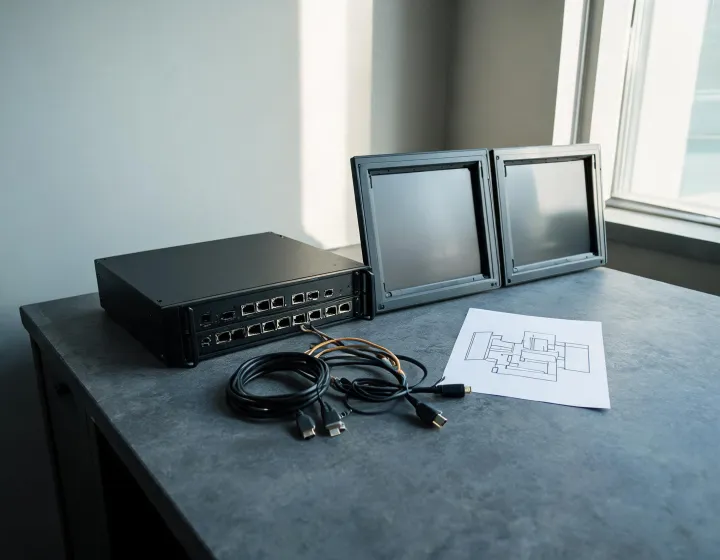
Each cell is a field the supplier should answer for the named model. This desk does not treat a family catalog as proof that the offered unit matches the cell.
Video path
Ask for the connector family on the console and on each host, the maximum resolution the supplier states, and whether EDID is emulated, learned, or left to the display. HDMI 2.0 is often discussed near 18 Gbit/s and DisplayPort 1.4 near 32.4 Gbit/s. Those are interface references, not a measurement this desk has made on a unit.
USB and audio
Separate keyboard and mouse HID from USB 2.0 at 480 Mbit/s and from a 5 Gbit/s or 10 Gbit/s USB 3.x peripheral path. State whether analog audio, a microphone, or neither is in scope. A switch that passes HID and nothing else is a different purchase from one that also passes a storage device. If a data switch shares the order, ask for forwarding rate and a Power over Ethernet budget in watts, such as 15.4 W, 30 W, or 90 W, on that separate line. Optical budget, wavelength, insertion loss, return loss, VSWR, impedance, frequency range, gain, MIMO, channel width, runtime, measurement accuracy, calibration traceability, connector mating cycle, and ingress protection are neighboring checks for optics, cables, radios, or meters, and they should not be copied onto the console model without a document.
Cable kit
Say if host cables, a console cable set, and power cords are included, excluded, or quoted as a separate line. Length matters: a 1.8 m set and a 3 m or 5 m set are not interchangeable in a deep rack. Ask for connector gender and whether the kit is bonded to the quoted model.
Commercial basis
Require quantity, currency, per-console or whole-order basis, Incoterms, freight, duties, and the lead-time basis. An optional target budget should name its currency and whether it is per unit or for the order. A buyer preference for high-end, mid-range, budget, or undecided is not a verified factory grade.